

 © Ben Leitner
© Ben Leitner
© Ben Leitner
Press Release
Global architects share inspiration for cities of the future at BRICK AWARD 26 Architecture Symposium
15. June 2026
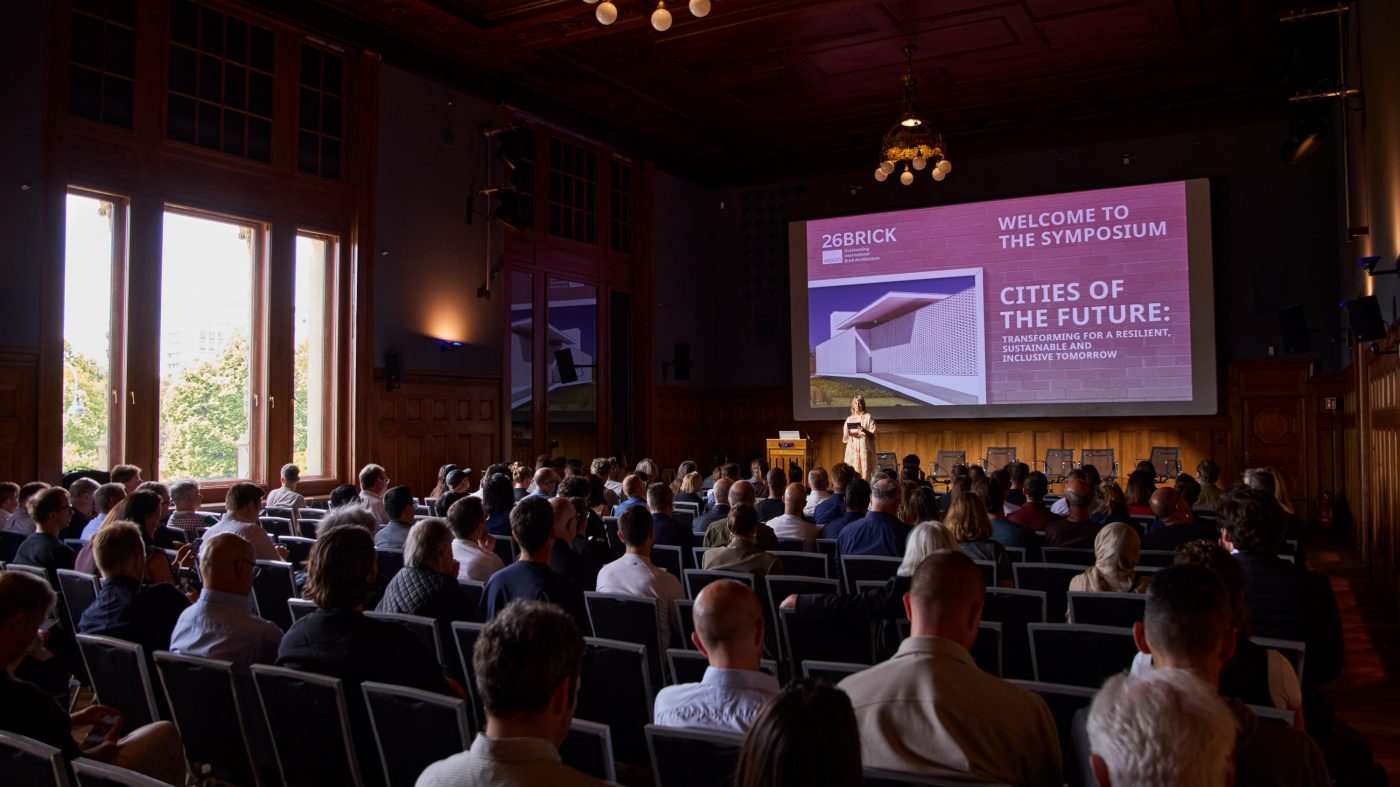
- The 12th biennial BRICK AWARD Architecture Symposium was held on Friday, June 12, 2026, at MAK Museum, Vienna
- Cities of the Future: Transforming for a Resilient, Sustainable and Inclusive Tomorrow showcased and debated best practice and architectural innovation from around the world
Vienna – With cities accounting for more than 70 per cent of global greenhouse gas emissions, and accelerating urbanization increasing exposure to climate and disaster risks, a select group of the world's leading architects gathered at the BRICK AWARD 26 Architecture Symposium in Vienna last week to discuss how they can help to ensure the cities of the future are resilient, sustainable and inclusive.
Since 2004, the biennial BRICK AWARD has been giving architects a platform for their unique designs and celebrating brick and ceramic building products as timeless materials for innovative and forward-looking architecture. Hosted by wienerberger, the independent awards bring together some of the world’s most inspirational and innovative pioneers of brick architecture, providing an unrivalled pool of knowledge and experience that is shared and developed at a symposium that takes place in the days following the awards ceremony.
Taking as its theme "Cities of the Future: Transforming for a Resilient, Sustainable and Inclusive Tomorrow", the BRICK AWARD 26 Architecture Symposium saw leading thinkers in the field discuss the critical role of architecture, urban planning and the building sector in creating the sustainable cities of the future.
Through a series of talks, the symposium presented innovative, radical and groundbreaking projects and ideas that sparked discussions on solutions and possibilities to form more resilient and liveable cities for all.
Architecture in dialogue with place, culture, and material
Daniel Mangabeira, co-founder of BLOCO Arquitetos, a leader in contemporary Brazilian architecture, highlighted the importance of "building with place" through the example of the Brazilian Cerrado, a vast ecologically rich but increasingly threatened territory in the heart of Brazil. By framing the Cerrado as both physical and cultural landscape, Mangabeira discussed how the work of BLOCO Arquitetos responds to environmental pressures and spatial inequalities in the region. “In Brasília, we inherited a modern architecture deeply connected to structure, light and landscape. Today, our challenge is to carry this legacy forward while responding to environmental fragility and contemporary social inequalities. In the Cerrado, one of the world’s most threatened biomes, architecture should incorporate the territory, recognizing its limits, preserving its memory and understanding the landscape itself as part of the project”, said Daniel Mangabeira. His insights helped delegates explore how architecture can reconnect construction with territory and address contemporary challenges while proposing more resilient and context-sensitive futures.
Turning to Vietnam for practical examples of how to embrace cultural sensitivity and inclusivity, ARB Architects founder Nguyen Há explained the concept of "Situated Serenity". This approach, deployed by Há through her MM Labs initiative, sees buildings not as objects, but as processes of knowledge making through matter. “Situated Serenity sees architecture as a living entity, constantly becoming through experimentation with matter, memory, and the belief systems of a territory”, said Nguyen Há. Working across research, experimentation and practice, Situated Serenity engages site-sourced materials, processes of making and tacit knowledge as living agents that carry memory, territory and systems of belief. In this sense, architecture becomes a living archive, where the sacred is not represented but gently constructed and experienced.
Preserving the past, shaping the future: architecture for resilient and livable cities
The symposium also considered examples of adaptive reuse strategies in West Africa, where Jeanne Autran-Edorh, co-founder of Studio NEiDA, believes there is much to learn from the architecture that precedes and exceeds the discipline as it is understood today. Studio NEiDA is engaged in documenting the modernist buildings produced in the decades following independence from former colonial powers, proposing futures for these structures that are rooted in the communities that inhabit them. “A resilient city is one that transforms and adapts what already exists. For the West African cities I work in, this means grappling with a building history whose transmission was violently disrupted by colonialism and then flattened by the dominant canon. The knowledge held in the hands of craftspeople and generations of builders risks being lost, while modern ruins are read as failure rather than potential. These multiple legacies, studied and applied with care, can ground an architecture fit for a future of communal urban life,” said Jeanne Autran-Edorh. Eschewing one-size-fits-all solutions, Autran-Edorh pointed towards the multitude of ways in which this can be achieved.
Brooklyn Bridge Park in the USA, which was funded by a self-sustaining economic model that has become a new standard for ambitious public space projects, was the subject of a talk by Matthew Urbanski, partner at MVVA. More than 20 years in the making, the park has transformed an abandoned waterfront into a public landscape visited by five million people a year. “Parks are the most vital and welcoming gathering places for urban communities providing a connection to nature and each other. We hope the creation story of Brooklyn Bridge Park inspires other cities to grasp the opportunities and tackle the challenges presented by large-scale civic landscape projects,” said Matthew Urbanski. The project sets a benchmark for waterfront projects globally that both reconnect cities to their shorelines and provide storm buffers in the face of climate change. The idea for Brooklyn Bridge Park came from the public in response to a proposed plan to build apartment towers at the water’s edge. Urbanski explored how, through advocacy and community engagement, the vision of an accessible, continuous riverfront park became a reality.
“Cities are big drivers of climate change, representing two-thirds of global energy consumption, but they are also hubs for creativity, innovation and education. Through sharing their innovations and experience, the architects attending the BRICK AWARD Architecture Symposium have the capacity to affect significant systemic changes across a range of critical areas, from climate change mitigation and adaptation to ecosystem preservation, restoration and circular economies.
Cultural sensitivity and human-centric design are also vital to ensure cities of the future succeed as places to live. Smart renovations that focus on the efficient use of energy and resources need to increase in scale and contribute to a sustainable and affordable housing sector, while accessible, high-quality green spaces are vital to support biodiversity, physical and mental health, and social well-being.”, says Heimo Scheuch, CEO wienerberger.
"wienerberger is proud to once again be providing a forum for the world's leading innovators to connect with their peers and further best practice in global architecture. The urgency of this debate and the insights it brings are vital not only for our industry but for the entire built world."

About the BRICK AWARD
The BRICK AWARD is an international architecture prize that celebrates outstanding brick architecture from around the world. Hosted by wienerberger, the award recognizes innovation, craftsmanship, and sustainable design, while remaining independent; use of wienerberger products is not a requirement for participation. Established in 2004, the biennial prize has become a prestigious platform for visionary architects, showcasing the creative and ecological potential of brick and ceramic materials in contemporary architecture. Winners from around the world are celebrated during an award ceremony, and their work is featured in the official BRICK book, alongside nominated projects.
Contact

Claudia Hajdinyak
Head of Corporate Communications
Wienerberger AG
© Daniel Hinterramskogler +43 664 8283183 Send e-mail