
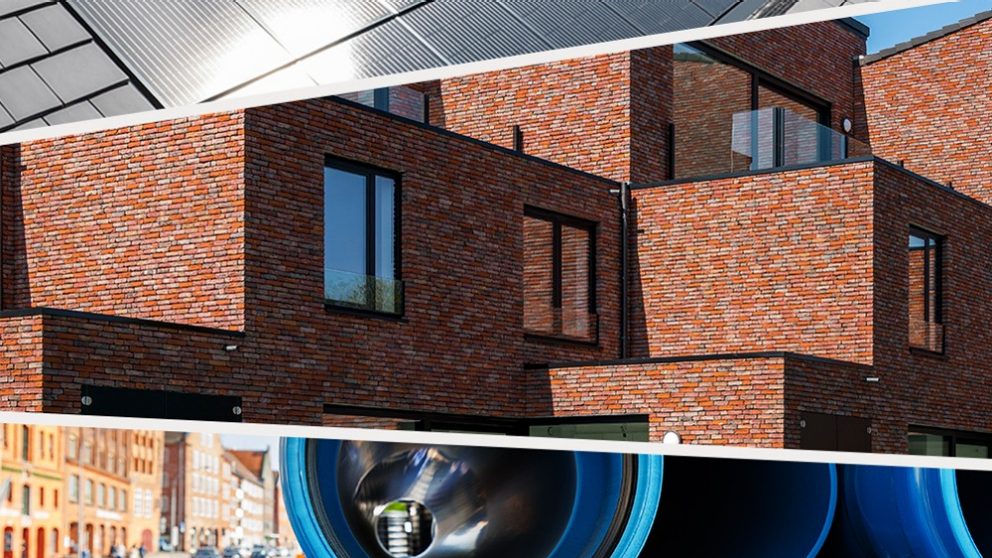


The wienerberger Sustainability Program 2023-2026
The wienerberger Sustainability Program 2023-2026 defines targets and actions in key sustainability areas and supports the company's long-term decarbonization efforts.
The program reflects the ceramic industries commitment to achieving climate neutrality by 2050 as outlined in the “Ceramic Roadmap to 2050”. The wienerberger sustainability targets have been developed taking into account relevant objectives of the EU Green Deal like decarbonization and circularity. We have adopted the ESRS reporting standards, provide high levels of transparency on our impact on the planet and people, and continue our improvement in this matter.
The current three-year wienerberger Sustainability Program covers the calendar years 2024, 2025 and 2026. The program extends the environmental and social topics, leveraging our sustainability targets to organic growth, both within our internal processes as well as assisting society with building products supporting energy efficiency through e.g. wienerberger´s high thermal performance wall systems and climate resilience through e.g. solutions that enable rainwater harvesting, greywater reuse and water-efficiency. It provides the right strategic and operational focus for the sustainable development of our business.
2026 Social Targets and Progress
Diversity & Inclusion

At wienerberger we put people first: We remain humble & embrace differences, we lead by example and act as advocates for diversity & inclusion and we offer our employees a safe and attractive working environment with development opportunities. But our commitment extends far beyond our colleagues at work. Because our solutions are developed by people, for people, we act in the interests of our customers, our partners, our staff, and society as a whole.
Development and implementation of inclusion and diversity action plan in all countries (2023 - 2026). Every action plan will include an equal pay and equal opportunity policy
The objective of realizing an inclusion and diversity action for all countries where wienerberger is active, is a large extension of our targets. The inclusion and diversity plans are a structure which will be implemented per country recognizing differences in culture and beliefs. By doing so the transition to increase diversity, equality and inclusion will be better embedded.
Health & Safety

20,000 visible leadership hours
As a social goal within the Sustainability Program 2023-2026, wienerberger continues its focus on personal health and safety, further striving towards the principle of zero harm. This emphasis will be supported by a stronger involvement of management in meetings on safety issues, aiming at 20,000 visible leadership hours.
Training & Development

18 hours of training per employee and year
Since wienerberger understands the value of employees’ professional advancement for the company's continued success, all employees will receive 18 hours of training per person and year. In addition, an accumulated 30,000 hours of training for installers will be provided as the lack of skilled persons on building sites is a major bottleneck for the current building industry. To support young talents especially, 500 apprentices will be trained until 2026.
Social Commitment

200 housing units for people in need built per year
wienerberger has established a long-lasting and trustful cooperation with Habitat for Humanity International. With this cooperation, we achieve a significant amount of housing units built for people in need per year in Europe and North America, supporting our target of building 200 housing units with our products for people in need in our local markets every year.
2026 Environmental Targets and Progress
Decarbonization and Energy Mix
Reduction in scope 1 & 2 CO2 emissions (2020 - 2026)
Reduction in scope 3 CO2 emissions (2022 - 2026)
wienerberger is committed to supporting the objectives of the European Green Deal. As part of its long-term climate strategy, the company supports the ceramic industries commitment to achieving climate neutrality by 2050 as outlined in the “Ceramic Roadmap to 2050“. To this end, we are pursuing a clear strategy set out in our Sustainability Program. We are committed to enhancing energy efficiency in production and transport. We continuously develop our product portfolio and technologies to address evolving customer needs, regulatory requirements and sustainability objectives, like energy efficiency, durability, recyclability, circularity, lower environmental impacts of our products).
25% reduction CO2 emissions scope 1 & 2 (2020 - 2026)
The reduction target of 25% in scope 1 (direct CO2 emissions from primary energy sources and from raw materials) & 2 (indirect CO2 emissions from wienerberger's electricity consumption; emissions from electricity generation) emissions by 2026 compared to the base year 2020 is a solid basis for achieving our vision to be climate neutral in 2050 as described in the “Ceramic Roadmap to 2050“.
10% reduction CO2 emissions scope 3 (2022 - 2026)
The scope 3 (emissions that are not produced by the company itself and are not the result of activities from assets owned or controlled by it, but by those that it's indirectly responsible for) reporting focuses on the three highly material categories for wienerberger, namely the emissions from purchased goods and services, fuel- and energy-related activities and downstream transportation and distribution. The reduction is to be realized by focusing on suppliers with lower emissions on raw materials. Our energy-related emissions are to be decreased by improved efficiency in the plants and producing our own renewable electricity. wienerberger’s transport efficiency per ton delivered shall improve by using vehicles with lower emissions.
15% of renewable energy used in own production (2023 - 2026)
The long-term development is strongly correlated with the usage of renewable energy resources. In the short-term, maximizing the sourcing of green electricity and using biogas in regions where this is available shall increase the usage of renewable energy in our own production. The centrally organized energy procurement and engineering organization supports and ensures the efficient transition.
Circularity

Since the early days in the history of wienerberger, it has always been our ambition to improve people’s quality of life and set new standards for the construction industry. To this end, we develop circular products like the click-brick system.
>80% of sales from highly durable products (>100 years)
The main goal in a circular economy is to minimize the extraction of raw materials and the generation of waste by promoting the reuseand recycling of products and materials. Durability plays a pivotal role in shifting from the traditional linear economy, where products are disposed of after a short lifespan, to a more sustainable circular economy that prioritizes resource efficiency, waste reduction, and environmental protection. Furthermore, durability is a leading circular principle as it directly addresses the issues of resource consumption and waste generation.
>90% of products sold are recyclable and/or reusable (2023 - 2026)
In our previous Sustainability Program 2020-2023 we focused on introducing products which are reusable and recyclable. Building on this achievement we are now able to report on the total sales of reusable and recyclable products within the new program. It is vital that we focus on developing innovative reusable products such as roof tiles and the click-brick system to advance our circularity objectives and support long-term business development.
Biodiversity

As a leading international provider of building material and infrastructure solutions, we seek to provide products and solutions that support sustainability objectives while managing environmental impacts and fostering long-term growth.
10% improvement of fauna, resulting from the implemented biodiversity plans, for all production plants (2023 - 2026)
Production sites have a biodiversity action plan based on the wienerberger Biodiversity Catalogue that outlines possible measures for biodiversity on a business premise. The action plans are documented within a geographic information system with digitally flagged potential biodiversity measures. By implementing these measures, we strive for an increase in the flora and fauna. Our biodiversity team collects and analyzes the data and supports the biodiversity community and ambassadors to learn and to improve the results.
400 biodiversity ambassadors trained (2020 - 2026)
We have targeted 400 ambassadors who shall be trained until 2026. Biodiversity ambassadors can measure fauna species such as birds, bees, and butterflies, which are indicators of a good biodiversity, and can have a positive effect on the production site and its surroundings.
100,000 trees planted, equaling to one tree per employee each year (2022 - 2026)
wienerberger is a supporter of the Global Biodiversity Framework and the EU Biodiversity Strategy for 2030. Planting trees supports this because of the benefits for ecosystems services that trees provide. They provide habitats for biodiversity, they sequester carbon, restore degraded soil, conserve water resources, and enhance the well-being of communities.
Revenue from products supporting net zero buildings
Driven by the consequences of the climate crisis, the key to the energy transition is sustainable energy management. In addition to circular economy, this also requires more energy efficiency in production and transport as well as an innovative and sustainable portfolio, particularly in the renovation sector, hence the main lever for energy management is the building sector.
75% of total revenue coming from building products contributing to net zero buildings
Existing buildings are responsible for approximately 39% of global energy and process-related CO2 emissions. This includes emissions from the operation and maintenance of buildings, which covers some 28%, as well as the energy for materials and construction which covers the remaining 11%. Hence, due to the big impact of the building sector on global emissions, the European Commission is focusing on regulations to move from "nearly zero-energy" buildings to "zero-emission" buildings by 2030, which is supported by the net zero building KPI. wienerberger’s innovative systems and technologies for the building sector have an essential role in designing, constructing, and operating net zero buildings. Driving development, growth, and availability of these products will be essential for the buildings sector and Europe’s ambition to become CO2 neutral by 2050. The target captures those product categories which support energy efficient buildings, such as systems for roofs, outer walls including façades, heating, cooling and solar power generation.
Targeting 75% of total revenue coming from building products contributing to net zero buildings in renovation and new build will provide a significant impact wienerberger can have on the reduction of CO2 emissions.
Water Management
In times of climate change, weather extremes like dry periods, floods, and heat waves are increasing around the world. At the same time, resources like water and energy are depleting and more and more natural land is being sealed with impermeable surfaces, which on the one hand prevents the natural infiltration of rainwater, thus having a negative impact on water supply and on the other hand leads to flooding. All these developments call for urgent action to effectively counter the effects of climate change, such as drought and flooding, and to sustainably use valuable resources and protect the environment.
35 million m3 of water harvested, retained, and saved through our products in infrastructure and agriculture cumulatively reported in this three-year period (2023 - 2026)
In water management the European policies urge companies to preserve and restore water. Due to climate change, longer periods of draught cause heat stress in cities and lower the output of our agricultural sectors. wienerberger continues to develop and provide solutions that support rainwater harvesting, water reuse and efficient water management.
The innovative solutions provided in water management ensure harvesting of water for ground water retention or it can be reused for various applications. With new smart technologies and innovative products, the water consumption in water-intense applications like agriculture can be lowered (e.g. pipes for drip irrigation). Increased sales in this application and innovations lead to an increase in the performance and m3 saved and will result in 35 million m3 of water harvested, retained, and saved through our products.
15% reduction of water consumption in own production (2023 - 2026)
Our second target under water management is to reduce 15% of our water consumption in our own production. The implementation of the target allows wienerberger to showcase the efficient usage of water in operations. For example, several production sites implement closed-loop water circuits, significantly reducing withdrawal volumes and improving reuse efficiency.
Waste Management
At wienerberger, we focus on the efficient use of energy and raw materials. This includes measures such as integrating recycled materials and reducing waste generation, as well as developing products and solutions that support circularity objectives. Less waste is good for the environment, protects people, and saves resources.
15% reduction of waste on production sites (2023 - 2026)
wienerberger is already active in the field of circularity and reuses the typical production waste in ceramic and plastic materials. Therefore, we have set a new waste reduction target which focuses also on generic categories of waste.
 © Marjolein den Hartog
 © Robert Staudinger
 © InputUX / Adobe Stock