Skip to content

Fully interconnected systems, digital simulations and data-driven decisions are simplifying and improving production processes. But where there are opportunities, there are also challenges.

Filipp Pühringer © Katharina Schiffl

Filipp Pühringer, Head of Industry 4.0 at wienerberger, gives us some insights into what production will look like in the future.

Summary

Robots, sensors and data platforms are already integral parts of the industrial production ecosystem. And this interconnectivity will only grow in future. Machinery will communicate in real time, decisions will be made by AI, and entire factories will virtually run themselves. This will also change the work carried out by people in the production process and the demands that are made on them – as well as customer wishes and expectations.

It is the year 2100. The shop floor is veiled in darkness broken only by solitary light barriers and the occasional flashing of sensors. The sole sounds are the whirring of the ventilation system and the steady rhythm of the production machines. Humanoid robots move sporadically between the machines as they perform a small number of operations on the equipment.

Everything comes together seamlessly in a control center

Production machines, robots and data – each element of the production process is connected and is steered from here. Algorithms ensure that production runs autonomously. As soon as parameters deviate from their set values, the system automatically takes corrective action.

What sounds like a scene from a science fiction film is in fact the future of manufacturing. 

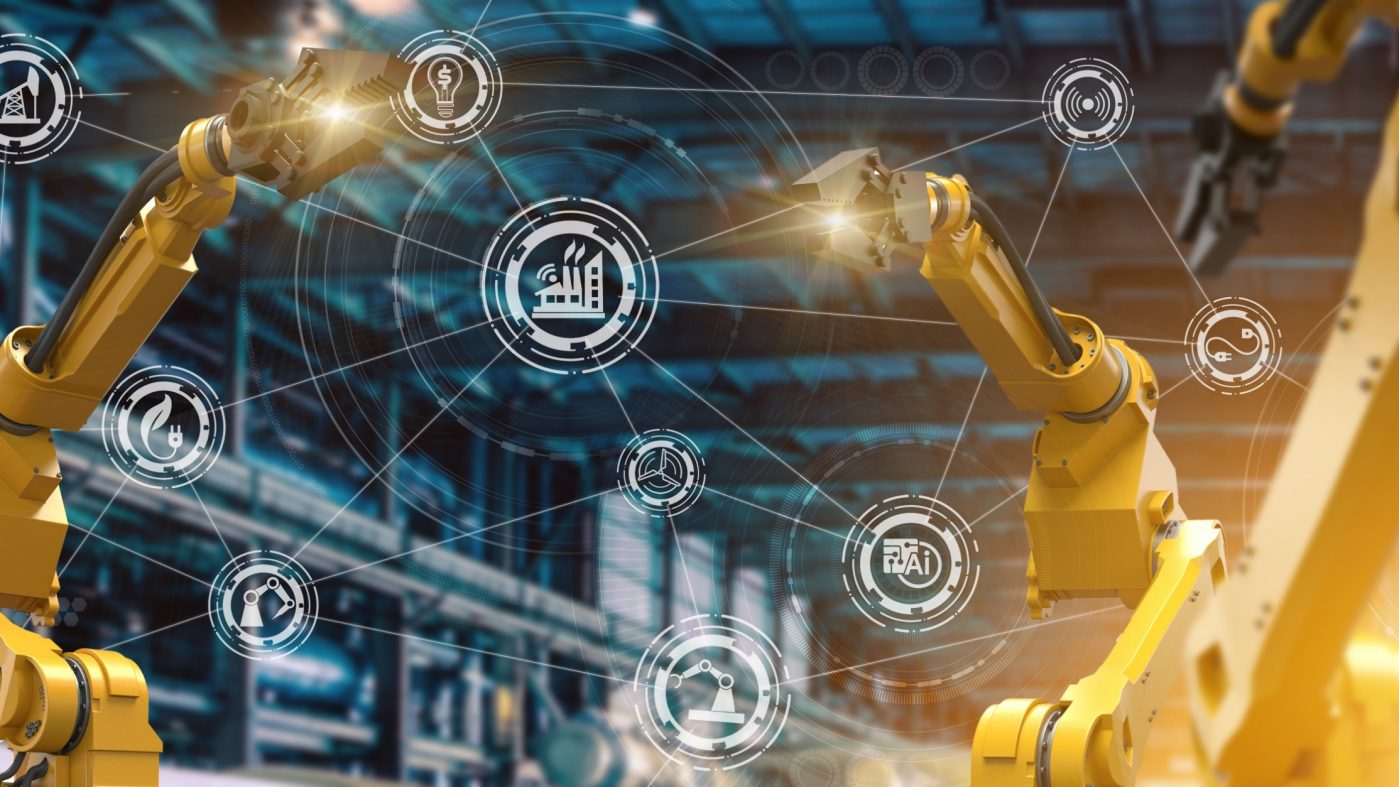
Industry 4.0 © Pugun & Photo Studio/Adobe Stock

Four Key Areas in the Factory of the Future

“The vision is a factory that runs like clockwork and without disruptions”, says Filipp Pühringer, Head of Industry 4.0 at wienerberger. This vision builds on four fields of action that will shape the manufacturing industry of the future:

1.

Smart factories, digital twins and complete connectivity

2.

Additive manufacturing and customization

3.

Data-driven value creation

4.

Collaboration between humans and machines


Machine Learning

Machine learning is a sub-field of artificial intelligence in which algorithms learn to recognize patterns from historical data and then make predictions or decisions. This allows processes to be optimized automatically and without manual intervention.

1. Smart Factories, Digital Twins and Complete Connectivity

“Industry 4.0 promises a fully networked production environment, where the machines are all connected to one another and where information is forwarded and can be seamlessly traced back”, explains Filipp Pühringer.

The crucial point: Complete connectivity enables the comprehensive collection of real-time data, which in turn forms the basis for creating digital twins. These virtually replicate physical production processes and machines on the basis of historical data thus depicting the behavior of the entire facility.

Making Production More Efficient, More Sustainable and Cheaper

Digital twins can also be fed with the latest measurement values from their physical counterparts, allowing predictions to be made or ”What if” scenarios to be simulated. These virtual tests can then run through countless possible optimizations, with the system automatically finding the best solution in almost real time.

Machine learning will play an enormous role in this context: the system processes input and target data, recognizes correlations and automatically adjusts parameters so that the results are gradually optimized.

But that is still a long way off, according to Filipp Pühringer: “we have to carefully weigh up the use of machine learning, as it also entails many risks. For wienerberger, the human-in-the-loop approach is therefore hugely important: a human operator retains control over the system and intervenes to ensure the quality and safety of our products.”

Digital twins enable precise production planning, the efficient use of resources and reduce malfunctions, resulting in an optimum use of resources, less waste, fewer downtimes and lower reject rates. The optimized use of resources and energy also has a positive impact on an organization’s environmental performance and ultimately on costs.

Connected along the Entire Value Chain

However, the potential of digital twins goes far beyond production optimization – it covers the entire value chain. “From sales to logistics, there are numerous processes that build on production data and vice-versa. Although today many steps have already been automated, this is by no means the case with all of them”, says Filipp Pühringer. 

“Digital twins not only make production more sustainable; they also make it more predictable, which means such twins are also financially attractive. They help avoid overproduction and excess inventories.“

Filipp Pühringer

Filipp Pühringer

Head of Industry 4.0, Strategy & Applications

Full interconnectivity will make it possible in future to automatically incorporate sales forecasts from the sales department into production planning. Precise production plans can then be generated that stipulate which machines manufacture which products, when and in what order. Optimum planning of the production sequence can, for example, reduce set-up times or facilitate the efficient use of waste heat.

Digital Twins at wienerberger

Digital twins are among the fastest growing concepts in Industry 4.0. wienerberger used its first digital twin in production in 2020 and has been consistently developing this technology ever since. Several million data points are now captured and analyzed in a central data bank every day. “In terms of technology, we already have everything we need at our disposal. However, scores of incremental development steps are still required for successful implementation”, explains Filipp Pühringer.

Challenges on the Path to Networked Production

This in fact is one of the key challenges: how to integrate and consolidate large amounts of data from a wide variety of sources. Data not only has to be meaningfully consolidated but also embedded in a reliable and scalable infrastructure. This increases the pressure to manage data responsibly. At the same time, it becomes clear how important it is for organizations to reduce their dependency on data centers and to ensure digital sovereignty by having their own cloud structures. 

Then there are the additional challenges of cybersecurity. For example, defending against ransomware – malicious software that can paralyze systems or encrypt data – or against targeted attacks that attempt to take control of systems. 

Machine Learning

Machine learning is a sub-field of artificial intelligence in which algorithms learn to recognize patterns from historical data and then make predictions or decisions. This allows processes to be optimized automatically and without manual intervention.


Additive Manufacturing with 3D Printing

A 3D printing system builds parts one layer at a time using liquid, powdered or solid material. This contrasts with conventional manufacturing processes, in which material is removed by milling or drilling or is pressed into a mold by casting.

2. Additive Manufacturing and Individualization

Once an experiment, 3D printing, or additive manufacturing as it is also known, is an indispensable key technology in the factory of the future. It constitutes an efficient alternative to manual manufacturing methods, especially when it comes to implementing complex technical requirements with a “production batch size of 1”, i.e. individual, tailor-made products.

Special software creates an optimum manufacturing program based on a 3D component drawing and the 3D printer produces the model 1:1 without time-consuming, error-prone cutting, welding or adjustment. In this way, customized solutions can be implemented in the shortest possible time.

Another big advantage of 3D printing is its design flexibility, since it can create shapes and constructions that are difficult or impossible to achieve using conventional methods. wienerberger’s solutions brand Pipelife already exploits this potential to the full and offers more than 400 quadrillion customization options for sewer bottoms.

At its solutions brand Semmelrock, which includes concrete pavers, slabs and paver accessories in its product range, wienerberger uses 3D printing for product development and for performance and design testing prior to market launch. “3D has simplified our development process and internal communication with other departments and countries. The prototypes make it much easier to coordinate design, product features and functions with customers”, says Filipp Pühringer.

Additive Manufacturing with 3D Printing

A 3D printing system builds parts one layer at a time using liquid, powdered or solid material. This contrasts with conventional manufacturing processes, in which material is removed by milling or drilling or is pressed into a mold by casting.


3. Data-driven Value Creation

The availability of large quantities of data is also changing value creation. There is no room in industrial production for gut feelings, experimentation or chance. Decisions are made on the basis of high-quality data that is intelligently linked and analyzed using AI.

This data-driven value creation is contingent upon data literacy, defined as the ability to interpret data correctly and use it in a meaningful way to draw accurate conclusions and make informed decisions.


4. Human-Machine Collaboration

Linear- and articulated robots are already used in production to perform a multitude of automation tasks. Filipp Pühringer expects that in future increased use will be made of humanoid robots. These are modelled on humans and can learn from them to imitate human activities. The question is, in which industries and areas these new types of robots will gain a foothold, and in what form and at what speed. As well as the challenges involved with this technology, the manager also sees great potential – especially in the area of occupational safety:

“We will be able to afford our employees better protection in the future as robots will be used more and more for activities that entail risks. They will also increasingly relieve people of monotonous and repetitive tasks, which is key for supporting mental and physical health. Achieving a fair balance between the costs, benefits and risks will always be paramount”, he explains.

There will be a shift in the role of humans away from that of operator to designer, with an increased focus on monitoring, controlling and creative tasks. “There will always be a human-in-the-loop .“

In this context, broader qualifications and in particular data literacy – or the competent handling of data – are becoming increasingly important. “Job profiles have always changed. Nobody today would want to make bricks the way they did 150 years ago. At the same time, we have to be aware that the pace of transformation is much faster today than in previous waves of innovation”, says Filipp Pühringer.

Besides the technological and organizational changes, customer expectations are also changing. “We must prepare ourselves for the fact that in future solutions that meet needs will be more important to our customers than mere ownership, the head of Industry 4.0 at wienerberger stresses. This means renting or leasing instead of buying. Parallels can be drawn for example from the automobile industry.

This development is opening up exciting opportunities for innovative business models: in keeping with the principle of circularity, manufacturers in future must think about how they can make their products reusable, recycle them or repurpose them for new uses. 

Conclusion

Fully interconnected production systems, digital twins and data-driven and AI-assisted decision-making are key characteristics of the factory of the future. They are fundamentally changing industrial value creation. Key technologies such as 3D printing relieve the pressure on employees while simultaneously improving safety at work. These developments open up huge potential for a more efficient, flexible kind of production that uses fewer resources as well as for new, forward-looking business models.

At present this is just a vision that raises an abundance of technical, organizational and ethical questions. Turning it into reality requires a careful weighing up of the costs, benefits and risks as well as balanced interaction between humans and machines.

Learn more about wienerberger

corp-no-news